
[et_pb_section fb_built=”1″ _builder_version=”4.27.4″ _module_preset=”default” custom_padding=”5px||0px|||” global_colors_info=”{}”][et_pb_row _builder_version=”4.27.4″ _module_preset=”default” custom_padding=”15px||12px|||” global_colors_info=”{}”][et_pb_column type=”4_4″ _builder_version=”4.27.4″ _module_preset=”default” global_colors_info=”{}”][et_pb_text _builder_version=”4.27.4″ _module_preset=”default” global_colors_info=”{}”]
Introduction to Spray Foam Insulation
[/et_pb_text][et_pb_text _builder_version=”4.27.4″ _module_preset=”default” global_colors_info=”{}”]
Spray foam insulation is a product used to insulate and seal within walls, ceilings, and other architectural structures. It is made from a mixture consisting of polyol resin, isocyanate, and a blowing agent. The insulation is spray-applied on construction sites to fill gaps and penetrate every crevice. This makes it a versatile and popular choice for both residential and commercial insulation. The foam expands after application, creating a layer of protection from heat loss, air filtration, and moisture penetration. This helps a structure to remain energy efficient with an airtight seal between indoor and outdoor climates. Spray foam can be eco-friendly and is durable for long-term use in structures because it avoids sagging, gapping, and other issues conventional insulations have.
While spray foam insulation is an excellent insulator, it does not always come without problems. These problems are partly due to a misunderstanding of how spray foam works and environmental variables. Understanding spray foam insulation enables easy troubleshooting of installation problems, from identifying the cause to solving the problem. A better understanding of spray insulation can also help property owners make informed decisions and weigh the advantages of installation with any potentially resulting issues. This guide includes a look at two types of spray foam insulation, how it works once installed, its main applications, and a few more misconceptions and misunderstandings about spray foam insulation.
[/et_pb_text][/et_pb_column][/et_pb_row][/et_pb_section][et_pb_section fb_built=”1″ _builder_version=”4.27.4″ _module_preset=”default” custom_padding=”5px||0px|||” global_colors_info=”{}”][et_pb_row _builder_version=”4.27.4″ _module_preset=”default” custom_padding=”15px||12px|||” global_colors_info=”{}”][et_pb_column type=”4_4″ _builder_version=”4.27.4″ _module_preset=”default” global_colors_info=”{}”][et_pb_text _builder_version=”4.27.4″ _module_preset=”default” global_colors_info=”{}”]
Types of Spray Foam Insulation
[/et_pb_text][et_pb_text _builder_version=”4.27.4″ _module_preset=”default” global_colors_info=”{}”]
When it comes to removing or replacing foam insulation, it is typically because of mold, high installation costs, or poor installation. The main problem seems to lie with foam that has not been installed properly; otherwise, it can be a very viable insulation solution. Contractors and homeowners should be well-versed in spray foam insulation and the three main types that you will find in the market. A key factor in deciding how to insulate a building is considering energy efficiency, the properties of the foam, and the climate that the building is in.
There are two main types of foam for spray insulation: closed-cell spray foam and open-cell spray foam. Open-cell foam is lighter, which makes it softer and spongier. These characteristics of the foam make it adhere to more irregular surfaces and effectively eliminate air infiltration. Open-cell insulation is the cheaper option because of its low chemical usage, and it is also vapor permeable. Closed-cell insulation is much denser than open-cell foam, which means it has a higher R-value, and because of how the cells in the foam are closed, it is also very resistant to moisture. Closed-cell foam will always stop the most air and water from getting underground compared to open-cell foam. This makes it very useful, particularly for extreme weather climates. It is very difficult for the installation process, and the biggest drawback is how unhealthy it is for the environment more than anything else.
[/et_pb_text][/et_pb_column][/et_pb_row][/et_pb_section][et_pb_section fb_built=”1″ _builder_version=”4.27.4″ _module_preset=”default” custom_padding=”5px||0px|||” global_colors_info=”{}”][et_pb_row _builder_version=”4.27.4″ _module_preset=”default” custom_padding=”15px||12px|||” global_colors_info=”{}”][et_pb_column type=”4_4″ _builder_version=”4.27.4″ _module_preset=”default” global_colors_info=”{}”][et_pb_text _builder_version=”4.27.4″ _module_preset=”default” global_colors_info=”{}”]
Open-cell vs. Closed-cell
[/et_pb_text][et_pb_text _builder_version=”4.27.4″ _module_preset=”default” global_colors_info=”{}”]
When discussing the different types of spray foam insulation products, it is important to recognize the structural differences between open-cell and closed-cell foams. Open-cell spray foam is, as its name suggests, “open” to its surroundings. Its structure is more sponge-like and porous, which ultimately results in a lighter and more breathable foam. These materials are popularly used for both DIY projects as well as in commercial applications where sound absorption is a major consideration, such as auditoriums. Open-cell foam is less water-resistant than closed-cell and has a lower resistance to vapor transmission; consequently, it should not be used in areas where it could be exposed to water, such as foundations and crawl spaces. Closed-cell foams, by comparison, are much denser and have a less permeable cell structure. Instead of being “open” to the outside world, like open-cell foam, this chemically constructed lattice structure is sealed, making these materials much more rigid. Primarily installed by professionals, the denser nature of closed-cell spray foam makes it much more resistant to both air and moisture infiltration. This foam is a popular choice for these two reasons and has been used in homes, post frame buildings, education facilities, and hospitals. If, for instance, you are in need of a material for the insulation of a pole barn or other industrial applications, closed-cell may be the more cost-effective choice. The material is more robust, having a higher R-value and a higher compressive strength than open-celled options and is less likely to require regular maintenance due to its durable nature. However, because of its structure and the expertise required to properly install it, closed-cell foams are occasionally more expensive to install than open-cell. It can also sometimes emit off-gasses, presenting a potential health hazard if not properly ventilated.
[/et_pb_text][/et_pb_column][/et_pb_row][/et_pb_section][et_pb_section fb_built=”1″ _builder_version=”4.27.4″ _module_preset=”default” custom_padding=”5px||0px|||” global_colors_info=”{}”][et_pb_row _builder_version=”4.27.4″ _module_preset=”default” custom_padding=”15px||12px|||” global_colors_info=”{}”][et_pb_column type=”4_4″ _builder_version=”4.27.4″ _module_preset=”default” global_colors_info=”{}”][et_pb_text _builder_version=”4.27.4″ _module_preset=”default” global_colors_info=”{}”]
Installation Process of Spray Foam Insulation
[/et_pb_text][et_pb_text _builder_version=”4.27.4″ _module_preset=”default” global_colors_info=”{}”]
Installation by spray:
1. Prepare the environment: Make sure the required safety measures are in place and that everyone has the tools and equipment needed to install the spray foam, such as safety glasses, knee pads, gloves, and a proper protective body suit for the two-component sprayed insulation foam. Good local exhaust ventilation is required.
2. Clean the surface to be insulated: Remove dirt and dust to ensure the surface is clean and dry. Grease and oil must be wiped off.
3. Monitor the moisture level: The surface to be insulated must be dry and the moisture level in the aggregate (typically not higher than 20%) must be measured to avoid condensation, especially on metal areas.
4. Heat or cooling? The temperature during the application depends on the type of foam to be used.
5. Apply the spray foam: There are various ways to apply spray foam. – The simplest way to apply the spray foam is to use a spray gun connected to two cylinders of spray foam. Trigger pulled, let the spray foam sit by expanding it until it is a little under the surface. – Spray-in application is also possible, using a hose to direct the liquid foam to the target area, and the foam expands and solidifies. The spray-in application may be used in small areas inside walls and for overhead applications.
6. Let the foam cure. – The expansion process continues over an hour or more until the foam finally hardens. If you are going to use a solid filler, make sure it does not exceed the maximum recommended depth. In general, there should be at least a 3/4 inch space between the top and bottom of the layer.
Spray foam insulation should also not be installed in a non-dispersive manner, disallowing leaks or seams because open cell resin can suck air. During wall and overhead applications, it will drop systematically to perform the so-called metal siding to avoid perching pockets. While the whole process sounds simple, holes, shifting, or moisture will sabotage your work if you are inexperienced or do not recognize potential deficiencies. You may want to employ a professional spray foam contractor to help you save some money because then it would be sustainable in the long term.
[/et_pb_text][/et_pb_column][/et_pb_row][/et_pb_section][et_pb_section fb_built=”1″ _builder_version=”4.27.4″ _module_preset=”default” custom_padding=”5px||0px|||” global_colors_info=”{}”][et_pb_row _builder_version=”4.27.4″ _module_preset=”default” custom_padding=”15px||12px|||” global_colors_info=”{}”][et_pb_column type=”4_4″ _builder_version=”4.27.4″ _module_preset=”default” global_colors_info=”{}”][et_pb_text _builder_version=”4.27.4″ _module_preset=”default” global_colors_info=”{}”]
Benefits of Spray Foam Insulation
[/et_pb_text][et_pb_text _builder_version=”4.27.4″ _module_preset=”default” global_colors_info=”{}”]
Spray foam insulation, a new and alternative way of insulating a home or commercial application, is pliable and flexible and fills the cavities before it dries, allowing it to expand and seal. It has completely replaced other forms of insulation in the past. In regard to its reduced allowable air infiltration, R-value per inch, mold’s ability to influence it, and its maintenance, it has been reported to outperform all other types of insulation. The main reason for its growing popularity is the improvement in home and building performance. Since it can be sprayed into wall openings, on roof decks and crawlspaces, and under floors, those hard-to-reach areas where traditional insulation types fail, spray foam insulation is preferred. Since it can easily fill in those spaces, it is an ideal air barrier.
Another significant advantage of spray foam is the soundproofing of a home or building. The majority of spray foam is derived from inert polymers. When properly installed, it does not emit harmful chemicals into the environment. Reducing energy consumption or keeping a home warm can result in financial savings, which means that the initial upfront cost of spray foam insulation is recouped after a period of time. An airtight structure without thermal gaps is more comfortable than a structure using other insulations. Spray foam finds and seals all gaps. This will also result in a reduction in air in the house. The indoor air quality of your home will improve due to the prevention of outside irritants such as allergens, pollen, and dust. When windows are closed, sound is reduced. As many people live in close proximity to busy transportation and downtown areas, soundproofing is valuable; remembering that spray foam is a mass, sound reduces at 2-4 decibels per inch of spray foam used. Spray foam’s resistance to water absorption derives from its composition. A safe environment is achieved by careful care.
[/et_pb_text][/et_pb_column][/et_pb_row][/et_pb_section][et_pb_section fb_built=”1″ _builder_version=”4.27.4″ _module_preset=”default” custom_padding=”5px||0px|||” global_colors_info=”{}”][et_pb_row _builder_version=”4.27.4″ _module_preset=”default” custom_padding=”15px||12px|||” global_colors_info=”{}”][et_pb_column type=”4_4″ _builder_version=”4.27.4″ _module_preset=”default” global_colors_info=”{}”][et_pb_text _builder_version=”4.27.4″ _module_preset=”default” global_colors_info=”{}”]
Energy Efficiency
[/et_pb_text][et_pb_text _builder_version=”4.27.4″ _module_preset=”default” global_colors_info=”{}”]
Spray foam insulation reduces the amount of heat moving in and out of your home. As a result, less energy is required to adequately cool and heat the living space. This influences the R-value of the insulation, defined as the material’s resistance to heat flow. Since homes lose and gain the majority of their heat through air exchange, it is essential to consider the air-barrier value alongside the R-value. Traditional insulation such as fiberglass batts, cellulose, blown-in insulations, and foam boards simply lay atop each other or the joists in the case of a finished attic or basement, temporarily reducing the heat transfer before air gets in. This is where spray foam insulation makes a big difference. Sprayed or injected, foam insulation expands quickly to fill even the tiniest nooks and crannies. The result is a more solid barrier that prohibits outdoor air from seeping in and indoor air from seeping out. In addition, many homeowners are now exploring foam insulation in tandem with traditional insulations to halt thermal bridging, reduce convection, and eliminate the “chimney effect.” Spray foam insulation has a higher R-value and is much more effective at insulating against heat transfer than other insulating materials. This means your home will consume significantly lower amounts of energy to cool and heat your living space, resulting in lower electric and gas utility bills. While the initial investment may be higher, the long-term cost savings are proportionate to the superior insulating properties of spray foam insulation. Air leakage is responsible for a significant amount of the energy lost in a structure, but foam insulation provides a complete airtight seal. As a result, structures constructed with spray foam insulation need not be ventilated to the same extent. When a building is airtight, it maintains a comfortable temperature with very little additional energy, and its output drops. With less energy demanded, less fossil fuel is used, resulting in a smaller carbon footprint. Additionally, if the outside of a home is very hot, the inside will remain cooler. In the winter, heat stays inside. The result is that over time, it is not only more energy-efficient buildings and homes that are sealed, but they are also easier to live in. In a traditionally insulated home, there are heat transfer problems in particular areas, whereas in a home with spray foam insulation, the heating is distributed in a more even and efficient manner.
[/et_pb_text][/et_pb_column][/et_pb_row][/et_pb_section][et_pb_section fb_built=”1″ _builder_version=”4.27.4″ _module_preset=”default” custom_padding=”5px||0px|||” global_colors_info=”{}”][et_pb_row _builder_version=”4.27.4″ _module_preset=”default” custom_padding=”15px||12px|||” global_colors_info=”{}”][et_pb_column type=”4_4″ _builder_version=”4.27.4″ _module_preset=”default” global_colors_info=”{}”][et_pb_text _builder_version=”4.27.4″ _module_preset=”default” global_colors_info=”{}”]
Air and Moisture Barrier
[/et_pb_text][et_pb_text _builder_version=”4.27.4″ _module_preset=”default” global_colors_info=”{}”]
Spray foam insulation serves as a superior air barrier by expanding and completely filling gaps and voids. Since foam is a spray-applied product, it fully adheres to the substrate, creating a tight seal that limits air infiltration. Air that carries moisture can lead to many issues such as mold, mildew, and condensation. Spray foam insulation is capable of preventing air, moisture, and vapor movement due to its expanding action. Addressing these concerning indoor air issues helps to improve indoor air quality, thereby making a healthier living environment. Controlling indoor air allows for controlled ventilation instead of relying on air leaking in or out through the architectural envelope. Increased indoor air quality can result in reduced allergens, dust, pollutants, noise pollution, and improved overall occupant health and comfort.
The actions of air sealing also stop moisture from the air from entering the building envelope. Excessive moisture and condensation can lead to mold or mildew growth, which can affect a building’s structural durability. Since the air tightness limits uncontrolled air, moisture, and vapor movement, there are several benefits. One benefit is energy efficiency since there is minimal temperature change due to air infiltration. Since there is little temperature change, air-tight buildings require less energy to maintain a comfortable living environment. A benefit of having a vapor and moisture barrier is the capability to load, contain, and control vapor and condensation migration. Drying potential can be controlled since the drying occurs mostly in one direction; this can accommodate the structural design and climate. Preventing water movement can also reduce the risk of rot from occurring; this also contributes to long-term durability and performance. A building’s durability can be significantly improved with the use of a vapor and water barrier. The spray foam insulation creates these air and water barriers by applying a dual-density foam, creating a tight seal.
[/et_pb_text][/et_pb_column][/et_pb_row][/et_pb_section][et_pb_section fb_built=”1″ _builder_version=”4.27.4″ _module_preset=”default” custom_padding=”5px||0px|||” global_colors_info=”{}”][et_pb_row _builder_version=”4.27.4″ _module_preset=”default” custom_padding=”15px||12px|||” global_colors_info=”{}”][et_pb_column type=”4_4″ _builder_version=”4.27.4″ _module_preset=”default” global_colors_info=”{}”][et_pb_text _builder_version=”4.27.4″ _module_preset=”default” global_colors_info=”{}”]
Reasons for Removing Spray Foam Insulation
[/et_pb_text][et_pb_text _builder_version=”4.27.4″ _module_preset=”default” global_colors_info=”{}”]
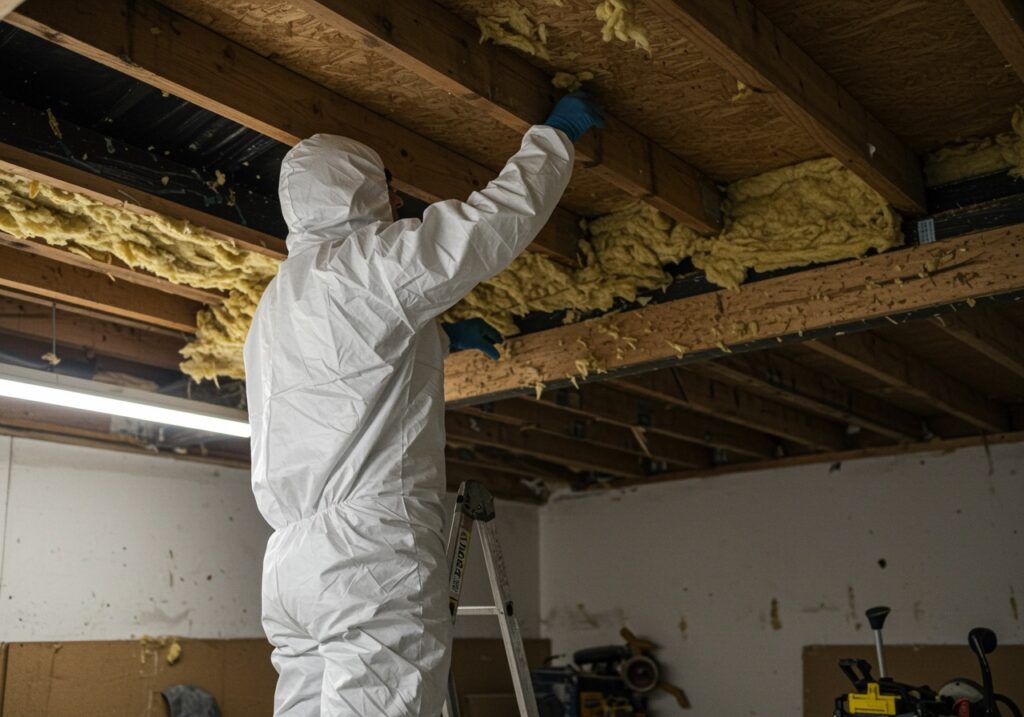
Concerns might develop after spray foam insulation is installed within a building, perhaps related to potential health risks or compromised comfort and safety. Possible health concerns could revolve around off-gassing of noxious chemicals, either during the insulation application process or over the expected service lifetime of the product. Installers of spray foam often report suffering from breathing issues if adequate personal protective equipment is not used. Guidelines identify the need for people and pets to be excluded from living spaces during and immediately after spray foam applications, with no specific mention of any subsequent off-gassing. Depending on the age and usage of the building where the spray foam application occurred, the health concerns may persist for some time. Although not true for all spray foams, problems related to conformance, connections, and compaction, or even complete failure of the insulation material, may develop over time or quickly if insulation is improperly executed. In such cases, removal of the insulation and resolution of any underlying issues that contributed to the original failure may be appropriate.
Trapped moisture, which can lead to mold or rot, has been identified as a problem in cavity-based, spray-applied, polyurethane foam insulated buildings when the exterior finishes or furring strips are not installed appropriately. In numerous cases, wood sheathing and/or some of the underlying framing members can rot so significantly that the buildings become unsafe before repair work can take place. Although not typical for properly designed and installed spray foam insulated buildings, any future or underlying alteration in climate, as well as building internal heat generation, can increase moisture loading in these assemblies. No additional compensatory drying ability typically exists in foam insulated walls, and eventual water saturation will occur without relocation and reappraisal of the VFs. Accommodating climate change and adjusting the use of building components are both part of the reasons for removing these VFs. As buildings age, many polymers become increasingly brittle and/or shrink and expand with increases and contractions to the shape and size of the buildings, which may result in cracking or peeling of the foam surfaces. Whereas these foam erosion concerns are general in all types of foam-based insulation, it is important to remember that the spray-applied forms pose a potential dust generation problem. Rapid, non-weathering, mechanical damage and scuffing can result, contributing to the above-noted operation and maintenance issues as well. Changes in climate or enclosure, particularly in heated and cooled environments by electrical or liquid means, can lead to a downgrade or nullification of insulation performance in all foaming insulation materials and their need to be extracted or revised.
[/et_pb_text][/et_pb_column][/et_pb_row][/et_pb_section]
Need Spray Foam Removed?
Our specialists are available throughout the Midlands. Call us on 0121 663 6529 for a free survey.
Get a Free Quote