
[et_pb_section fb_built=”1″ _builder_version=”4.27.4″ _module_preset=”default” custom_padding=”5px||0px|||” global_colors_info=”{}”][et_pb_row _builder_version=”4.27.4″ _module_preset=”default” custom_padding=”15px||12px|||” global_colors_info=”{}”][et_pb_column type=”4_4″ _builder_version=”4.27.4″ _module_preset=”default” global_colors_info=”{}”][et_pb_text _builder_version=”4.27.4″ _module_preset=”default” global_colors_info=”{}”]
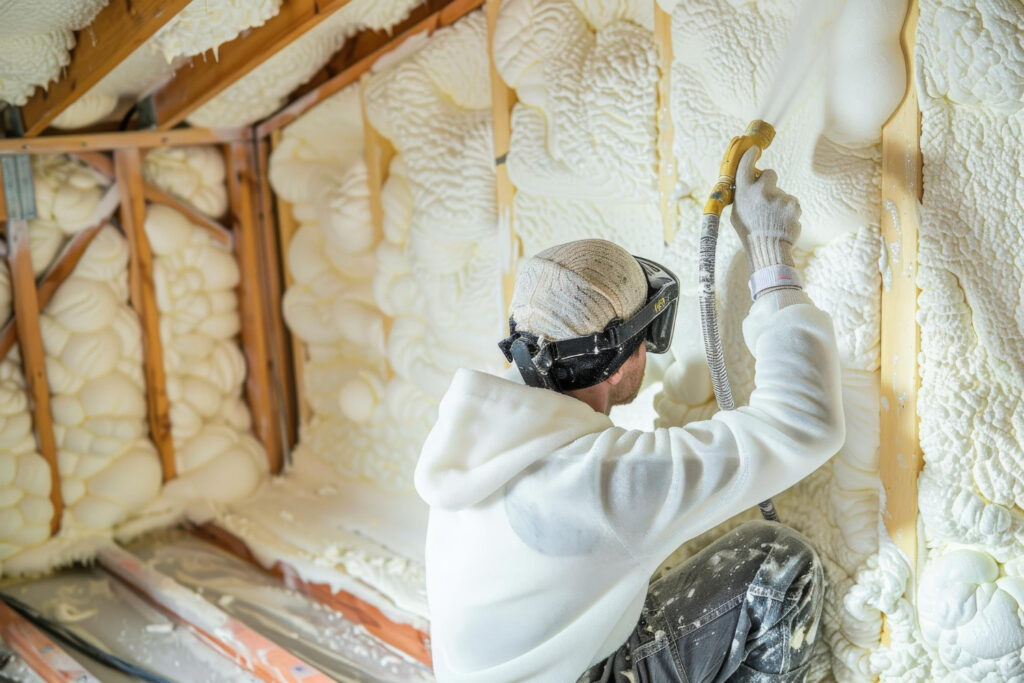
Spray foam is the term used to describe an expanding plastic that has been processed to create thousands of microscopically small bubbles. When these bubbles cure, open-cell or closed-cell foam is formed. Used to insulate homes for almost 40 years, spray foam is a product widely found in commercial, institutional, and residential properties. The primary purpose of insulation is to reduce unwanted heat flow and air infiltration. Properly selected, placed, and installed insulation reduces cooling and heating loads and can not only decrease energy costs but also improve building comfort. Air sealing is often included as an attribute of insulation, and spray foam meets both criteria. When properly applied, spray foam can make homes more energy efficient, quieter, safer, and more comfortable.
Spray foam offers a long service life and installation advantages over other varieties of insulation. Because of the value these attributes bring to a building, it is important to understand the longevity of these materials and to understand the likelihood and potential modes of deterioration. Spray foam is popular in sustainable design because of its air sealing performance, which is superior to that of traditional insulation materials. Often overlooked, however, is the role the material can play in constructing an energy-efficient structure. A strong, lasting envelope shedding almost no energy short circuits traditional controls on energy efficiency. As a lightweight material serving two functions, its application can result in time savings in construction. Over the four decades spray foam has been used commercially, its longevity has been questioned. There is an obvious desire within the built environment to know what materials will do, and likely, if we want buildings to last, we use materials known to be durable. The field observations on age-tested foam are the first steps.
[/et_pb_text][et_pb_text _builder_version=”4.27.4″ _module_preset=”default” global_colors_info=”{}”]
Definition and Types of Spray Foam Insulation
[/et_pb_text][/et_pb_column][/et_pb_row][/et_pb_section][et_pb_section fb_built=”1″ _builder_version=”4.27.4″ _module_preset=”default” custom_padding=”5px||0px|||” global_colors_info=”{}”][et_pb_row _builder_version=”4.27.4″ _module_preset=”default” custom_padding=”15px||12px|||” global_colors_info=”{}”][et_pb_column type=”4_4″ _builder_version=”4.27.4″ _module_preset=”default” global_colors_info=”{}”][et_pb_text _builder_version=”4.27.4″ _module_preset=”default” global_colors_info=”{}”]
Spray foam insulation, or spray foam, is a rigid cellular plastic that is mixed at the application site and applied wet in the form of a foam, which then expands further to fill installation cavities. Spray foam is characterized by its high R-value, low air infiltration, low sound transmission, and other attributes that make it preferable to other insulation types. Spray foam offers two major types: open-cell and closed-cell. Open-cell spray foam has a vapor-permeable arrangement of cells. It is mainly an air barrier due to low-density installations, but it can also serve as a semi-rigid insulation. It is often utilised for interior installations in commercial buildings. Closed-cell spray foam has a vapor-resistant polyurethane arrangement of cells that are closed and packed together. It provides a moisture and air barrier in addition to offering a high R-value. As such, it is often used for exterior walls and roofing, as well as below-grade installations.
The physical and chemical performance features of the above categories of foamed insulation products can be strongly influenced by design illustrations, raw ingredient selections, and process protocols. Particular product capabilities and robustness vary among manufacturers. It is important to use representation data or physical/material testing to ascertain the efficiency of foam barriers and insulation for a desired type or certain formulation. Different manufacturers may offer products with different levels of durability and service life. Not all cellulosic materials will impact the lifetime or durability of spray foam insulation unless the foam is selected for usage and components in the settings in which it is applied.
[/et_pb_text][et_pb_text _builder_version=”4.27.4″ _module_preset=”default” global_colors_info=”{}”]
Factors Influencing the Longevity of Spray Foam
[/et_pb_text][/et_pb_column][/et_pb_row][/et_pb_section][et_pb_section fb_built=”1″ _builder_version=”4.27.4″ _module_preset=”default” custom_padding=”5px||0px|||” global_colors_info=”{}”][et_pb_row _builder_version=”4.27.4″ _module_preset=”default” custom_padding=”15px||12px|||” global_colors_info=”{}”][et_pb_column type=”4_4″ _builder_version=”4.27.4″ _module_preset=”default” global_colors_info=”{}”][et_pb_text _builder_version=”4.27.4″ _module_preset=”default” global_colors_info=”{}”]
- Quality materials are more durable. This general statement traverses all manner of goods and building products, including insulation such as spray polyurethane foam. Spray foam can last indefinitely, but only if it remains durable and doesn’t fall into disrepair over time. Two main factors affect the longevity of a spray foam insulation application: materials and installation. The quality of the spray foam and a thoroughly inspected competent job focus on the installation of spray foam insulation. Materials matter too, especially when it comes to longevity. However, purchasing high-quality spray foam insulation doesn’t necessarily guarantee long-term quality. A competent installation job does. Purchasing a drum of quality, brand-new spray foam insulation formulation won’t inherently make that particular application durable if poor technique is used to install it inside the building. Given potential repair problems, homebuilders and likely homeowners could find appeal in the longer-lasting categories. Longevity factors that may be especially of interest include:
- Materials
- Installation
- Environmental exposure
- Building maintenance
[/et_pb_text][et_pb_text _builder_version=”4.27.4″ _module_preset=”default” global_colors_info=”{}”]
Quality of Installation
[/et_pb_text][/et_pb_column][/et_pb_row][/et_pb_section][et_pb_section fb_built=”1″ _builder_version=”4.27.4″ _module_preset=”default” custom_padding=”5px||0px|||” global_colors_info=”{}”][et_pb_row _builder_version=”4.27.4″ _module_preset=”default” custom_padding=”15px||12px|||” global_colors_info=”{}”][et_pb_column type=”4_4″ _builder_version=”4.27.4″ _module_preset=”default” global_colors_info=”{}”][et_pb_text _builder_version=”4.27.4″ _module_preset=”default” global_colors_info=”{}”]
The quality of a foam’s installation is a determinant in the longevity of spray foam insulation. While poured, rigid, and boardstock foam could also be installed poorly or used outside of the material’s performance parameters, the advantages of sealing the building shell and improving its thermal performance are simply not realized due to improper application of the foam. The effectiveness of a piece of spray foam can be further inhibited, and its lifespan shortened, if it is unevenly applied. Correct installation allows the foam to do its job of thoroughly insulating and sealing a building. If not, a number of problems can occur, and the foam may actually cause more harm than good. In this section, we discuss both how the application affects the product and how the choice of application can influence the product’s lifespan.
An installer can choose better quality reactions, appropriate application techniques, and in the application process, the installer’s placement and movement of the spray nozzle can further influence the result. Quality control programs have been developed to ensure that only qualified professionals install spray foam. Opening these programs to the general public would eliminate or greatly reduce the insulation value of the foam. Moreover, even the spray-applied foam that is correctly installed will not perform outside of its stated characteristics if it is installed in a manner that does not meet the recommendations for achieving the desired results. Most, if not all, standards that require compliance are based, to varying degrees, on product installation guidelines. Prior to or at the onset of installation, installers must be familiar with the resin and isocyanate that is to be used. A great deal of information can be obtained from safety data sheets that must be supplied. Is the isocyanate monomer or prepolymer based? Will it be effective in vinyl-coated, galvanised sheet steel? Is the resin to be installed with 98 percent pure nitrogen or 98 percent pure CO2 feet per minute? What is the recommended maximum lift of the foam? How is the foam to be cavitated and dressed after allowing the foam to develop primary adhesion?
[/et_pb_text][et_pb_text _builder_version=”4.27.4″ _module_preset=”default” global_colors_info=”{}”]
Signs of Deterioration in Spray Foam
[/et_pb_text][/et_pb_column][/et_pb_row][/et_pb_section][et_pb_section fb_built=”1″ _builder_version=”4.27.4″ _module_preset=”default” custom_padding=”5px||0px|||” global_colors_info=”{}”][et_pb_row _builder_version=”4.27.4″ _module_preset=”default” custom_padding=”15px||12px|||” global_colors_info=”{}”][et_pb_column type=”4_4″ _builder_version=”4.27.4″ _module_preset=”default” global_colors_info=”{}”][et_pb_text _builder_version=”4.27.4″ _module_preset=”default” global_colors_info=”{}”]
One of the key signs that your spray foam insulation, or other types of insulation, may have been compromised in some way is visible damage. The most noticeable problems are typically found on the outside of spray foam insulation. Look for signs of surface deterioration on the insulation layer, such as peeling, blistering, chipping, or erosion, as well as indentations or scratches that could be signs of damage from impacts. Peeling and separation of insulation sections are common indications of wear or misuse. Inside the cavity or wall, you may become aware that insulation has become compacted, fallen down, or developed voids and gaps.
Certain environmental factors can also impact the longevity of spray foam insulation. This insulation material may deteriorate more rapidly if it is subjected to long-term direct exposure to excessive moisture, UV light, or extreme temperature conditions. Inside the home, prolonged exposure to high relative humidity or a buildup of water within the wall assembly may result from roof leaks, plumbing leaks, or condensation from an indoor air conditioning system. Regularly monitor for and promptly repair sources of moisture or wall leaks to prevent hazardous situations, such as mold or mildew infestation. Insulating foam that was installed incorrectly or that has settled into voids could be infiltrated by household pests or, in extreme cases, inhabited by pests. Maintain your insulation with regular inspections, just as you would with your heating and cooling system.
[/et_pb_text][et_pb_text _builder_version=”4.27.4″ _module_preset=”default” global_colors_info=”{}”]
Visible Damage and Cracking
[/et_pb_text][/et_pb_column][/et_pb_row][/et_pb_section][et_pb_section fb_built=”1″ _builder_version=”4.27.4″ _module_preset=”default” custom_padding=”5px||0px|||” global_colors_info=”{}”][et_pb_row _builder_version=”4.27.4″ _module_preset=”default” custom_padding=”15px||12px|||” global_colors_info=”{}”][et_pb_column type=”4_4″ _builder_version=”4.27.4″ _module_preset=”default” global_colors_info=”{}”][et_pb_text _builder_version=”4.27.4″ _module_preset=”default” global_colors_info=”{}”]
Visible damage seems to be a common problem in deteriorating spray foam. In the majority of buildings and facilities, the most common place to observe deterioration is on the outside, exposed surfaces. Unfortunately, the chuckling, peeling, and visible discoloration are possibly the usual signs that indicate some troubles. This sign is considered one of the factors that can affect the system’s insulation, performance, and energy consumption. The effects of thermocyclic behavior, namely the large daily variation of temperature and high diurnal range, can also cause tiny and invisible cracks to form against the naked eye. The cracks immediately across from each other, however, might still show some signs on the backside of the substrate. This should have been treated immediately by sealing the crack instead of ignoring the problem unless it gets worse, propagates, and expands.
The trouble and deterioration could continue if those tiny and invisible cracks start to inflate whenever the substrate absorbs moisture and expands and contracts with temperature changes. The problem will be deeper once the coat is delaminated from the substrate. The moisture or water would be trapped, causing more damage, decaying the wood, such as rot, or damaging the masonry. If the exterior damages are not observed and monitored, it will extend the time and cost of a more extensive renovation. As an alternative to thoroughly checking the spray foam system, more broadly applicable and practical methods aimed at searching for the type and extent of any visible damages, such as delamination, blistering, peeling, cracking, or soft spots on the spray foam through regular observation, are advised. Such monitoring can be included in a building inspection program for both residential and commercial buildings.
Inspecting any potential damages in spray foam should be carefully conducted since not all signs of deterioration are visible during typical pre-purchase and pre-inspection building surveys. The exterior cladding can mask some potential issues of deterioration or damage, especially in a residential house. A process often helps to observe damages even by a layperson without costly equipment, software, or expertise. Some detection tests can be carried out on the surface of the spray foam to check if they are still firm or already softened. If the thermography image shows some damp or cold spots, it is best for the commercial building’s facility manager or homeowner to immediately take some necessary actions to further investigate the insulation system.
[/et_pb_text][et_pb_text _builder_version=”4.27.4″ _module_preset=”default” global_colors_info=”{}”]
Preventative Maintenance and Repair
[/et_pb_text][/et_pb_column][/et_pb_row][/et_pb_section][et_pb_section fb_built=”1″ _builder_version=”4.27.4″ _module_preset=”default” custom_padding=”5px||0px|||” global_colors_info=”{}”][et_pb_row _builder_version=”4.27.4″ _module_preset=”default” custom_padding=”15px||12px|||” global_colors_info=”{}”][et_pb_column type=”4_4″ _builder_version=”4.27.4″ _module_preset=”default” global_colors_info=”{}”][et_pb_text _builder_version=”4.27.4″ _module_preset=”default” global_colors_info=”{}”]
Preventative maintenance: Spray foam insulation systems are designed to work for decades with only minimal maintenance. Preventative maintenance is important because it can identify potential issues early before they become large issues. Maintenance practices include the tasks that can be performed by the homeowner as well as the tasks that should be performed by the installer. Each insulation material and type will have different maintenance requirements. Always clean up any debris around insulation systems. Look inside, look outside, and remove any items that will trap water, hold heat, or breed insects or rodents. Where access allows, every five years, the homeowner should recaulk or seal windows and doors to prevent moisture and air filtration. Check attic insulation for changes due to dust, debris, insects, or rats a minimum of once each season. Look for signs of moisture or water damage. Keeping good records on your insulation and the work performed will help inform the next owner of the home and offer peace of mind to you.
Repair: Insulation should be visually inspected at regular intervals. Repairs to spray foam systems are relatively easy and inexpensive. Using foam applied with similar systems is the easiest vehicle for repairs. Surface repair using high-quality caulk, extension hoses, and a high-quality cellulose insulation patch is also appropriate. Vacuums may be used to remove loose, dry materials such as fiberglass or cellulose before or after small repairs are made. Many times, old, dry materials can be removed to the center of the cavity, and closed-cell spray foam can be used to lock down the dust and debris while providing an air seal across the cavity. Always take care in drilling spray foam insulation. If a drill bit “grabs” as it starts to pass through the insulation, the installer has drilled a little too far. Never force a drill bit into spray foam insulation. Take the bit back and out and move it a little to the side. Always use care when trimming the surface of large spray foam pour areas. Always seal insulated containers holding liquids to prevent contamination. Always install carbon monoxide detection devices with battery backup capability. Always change batteries in detection devices when daylight saving time changes.
[/et_pb_text][et_pb_text _builder_version=”4.27.4″ _module_preset=”default” global_colors_info=”{}”]
Regular Inspections and Maintenance Practices
[/et_pb_text][/et_pb_column][/et_pb_row][/et_pb_section][et_pb_section fb_built=”1″ _builder_version=”4.27.4″ _module_preset=”default” custom_padding=”5px||0px|||” global_colors_info=”{}”][et_pb_row _builder_version=”4.27.4″ _module_preset=”default” custom_padding=”15px||12px|||” global_colors_info=”{}”][et_pb_column type=”4_4″ _builder_version=”4.27.4″ _module_preset=”default” global_colors_info=”{}”][et_pb_text _builder_version=”4.27.4″ _module_preset=”default” global_colors_info=”{}”]
To ensure the maximum longevity of spray foam insulation, regular inspections are necessary to monitor for maintenance. These check-ups can typically be performed by homeowners looking for obvious signs of damage or leaks. Full inspections at least once a year or once every year and two months are recommended to ensure that the foam has not been physically damaged and to check for leaks. If any signs of wear are present before or after the warranty, professional help should be contacted. Small repairs may be necessary between warranty-compliant annual inspections. If repairs are neglected, the structural soundness of the building may be compromised by leaks, ultimately leading to insulation replacement. Early detection and repair cost a small amount of money in regular maintenance but can potentially prevent larger, prohibitively more expensive repairs.
Small problems can escalate very quickly, as water saturation causes hydrostatic pressure on the foundation or carries harmful substances from roof water drains. Due to the considerable external temperature changes, the roof faces particularly high thermal stresses on the outside; on the inside lies a very damp and, accordingly, insulating high-quality adhesive. Hence, an annual or biannual inspection of both the inside and outside is recommended, mostly in the spring and then in the autumn. A homeowner has ladders for an exterior inspection and can check the interior with sufficient lighting. In the interior, an early diagnosis of insulation aging and any related replacement need is indicated by finding a few insulation pads near the surface with open cells.
[/et_pb_text][et_pb_text _builder_version=”4.27.4″ _module_preset=”default” global_colors_info=”{}”]
Conclusion
[/et_pb_text][/et_pb_column][/et_pb_row][/et_pb_section][et_pb_section fb_built=”1″ _builder_version=”4.27.4″ _module_preset=”default” custom_padding=”5px||0px|||” global_colors_info=”{}”][et_pb_row _builder_version=”4.27.4″ _module_preset=”default” custom_padding=”15px||12px|||” global_colors_info=”{}”][et_pb_column type=”4_4″ _builder_version=”4.27.4″ _module_preset=”default” global_colors_info=”{}”][et_pb_text _builder_version=”4.27.4″ _module_preset=”default” global_colors_info=”{}”]
In summary, most of today’s high-quality spray foam products are considered to offer a lifetime of reliable performance. Failures and degraded performance generally result from a lack of professional attention and mistakes that were made during application. For this reason, regular maintenance is one of the best ways to guarantee spray foam will continue to perform effectively. It is important to periodically examine insulation for signs of deterioration, including a reduction in R-value, open-cell structure, or complete decomposition. Although damage is generally centered around the UV-exposed exterior, considerable investigation and repair will likely be needed after any spray foam damage occurs.
By specifying the appropriate type of spray foam and ensuring the property is a good application candidate, home and property owners can increase their insulation’s odds of a long lifespan. Open-cell can be effective in any spray foam application, but should not be used in unventilated enclosed spaces, overall whole-house use, or as an air barrier without additional vapor control.
In conclusion, the answer to the question “How long does spray foam insulation last?” is twofold. For most brands and types of spray foam, the material should offer a lifetime of concrete benefits. Basic, uncovered foam should last at least half a century without a reduction in R-value. As long as it is kept dry, foam can last indefinitely. However, proper installation is essential, as is ongoing maintenance, in order to enjoy this lifespan. By keeping realistic expectations, paying for a job done right, and questioning brands that claim unrealistic longevity, property owners can truly benefit from the product. With this information in mind, it is possible to find a spray foam solution that is right for you.
[/et_pb_text][/et_pb_column][/et_pb_row][/et_pb_section]
Need Spray Foam Removed?
Our specialists are available throughout the Midlands. Call us on 0121 663 6529 for a free survey.
Get a Free Quote